INTRODUCTION
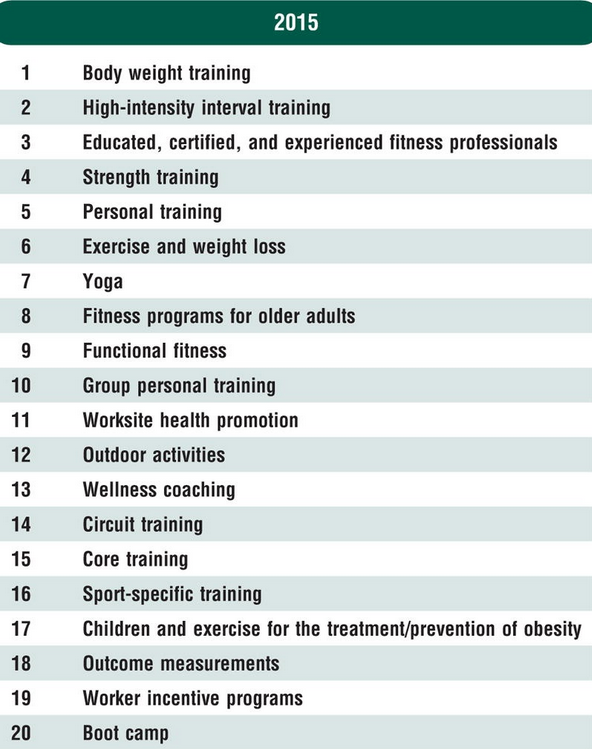
The annual survey is now in its ninth consecutive year, and this year with some not so very surprising results. High-intensity interval training took over the no. 1 spot in 2014 previously held by educated, certified, and experienced fitness professionals, which was in that position since 2008 and now appears at no. 3. But body weight training took over the no. 1 spot for 2015. The 2015 ACSM Worldwide Survey of Fitness Trends continues to support previous trends and also reinforced the deletion of four trends that had appeared to be strong for several years but now have dropped off the list. Zumba®, which first appeared in the top 10 (no. 9) in 2012, fell to no. 13 in 2013, dropped off the list of top 20 last year, and dropped further down the list in 2015 (no. 28 in 2014 and no. 34 in 2015). Pilates, indoor cycling, stability ball, and balance training again failed to appear on the list of top 20 trends in the health and fitness industry, which supports the theory that these were fads and not trends. Some of the survey respondents still argue that the persistent sluggish economy has influenced the results of this survey and that training programs requiring expensive equipment or technical instruction are not supported because of the increased cost. Still others argue that Zumba®, indoor cycling, and Pilates have run their useful course. The results of this annual survey may help the health and fitness industry make some very important investment decisions for future growth and development. Important business decisions should be based on emerging trends embraced by health fitness professionals and not the latest exercise innovation marketed during late-night television or the next hottest celebrity endorsing a product. To see a video summary, click here: http://links.lww.com/FIT/A18.

Walter R. Thompson, Ph.D., FACSM,
During the last 8 years, the editors of ACSM’s Health & Fitness Journal® have disseminated this electronic survey to thousands of professionals worldwide to determine health and fitness trends. The survey in this issue of the Journal helps to guide health fitness programming efforts for 2015. The first survey (1), conducted in 2006 (for predictions in 2007), developed a systematic way to predict health and fitness trends, and surveys have been done annually since that time (2–8) using the same methodology. As this was a survey of trends, respondents were asked to first make the very important distinction between a “fad” and a “trend.”
Read the full article here


